“The [global] HIV response is no longer only facing a funding crisis; it is becoming a crisis of survival for many people who use drugs.”
This warning from the Director of the International Network of People who Use Drugs (INPUD), Anton Basenko, set the tone for Youth RISE’s participation this June and July at the 58th Program Coordinating Board (PCB) meeting of th Joint United Nations Programme on HIV/AIDS (UNAIDS) in Geneva, a bi-yearly gathering of the governing body that discusses and determines UNAIDS’ objectives.
This year’s meeting met amidst a global health infrastructure forced to scale back or shut down entirely due to sweeping foreign aid cuts implemented throughout 2025 and 2026, which massively destabilized harm reduction access and programming, directly endangering global communities of people who use drugs and who live with HIV who depend on such lifesaving resources. Already, frontline organizations have been forced to absorb the toll of these cuts: 30% of those surveyed by INPUD on the impacts of U.S. funding contractions have witnessed a spike in fatal overdoses, while 62% have reported escalating stigma and discrimination within their service populations.
Now, with the UN Secretary-General proposing to sunset UNAIDS by the end of 2026, structural protections for marginalized and criminalized key populations risk being completely dismantled.
In the face of these threats, Youth RISE made the case for the importance of funding civil society organisations and communities that support those most impacted by HIV, and to end punitive laws and policies that prevent nations from implementing drug control systems based on human rights and public health.
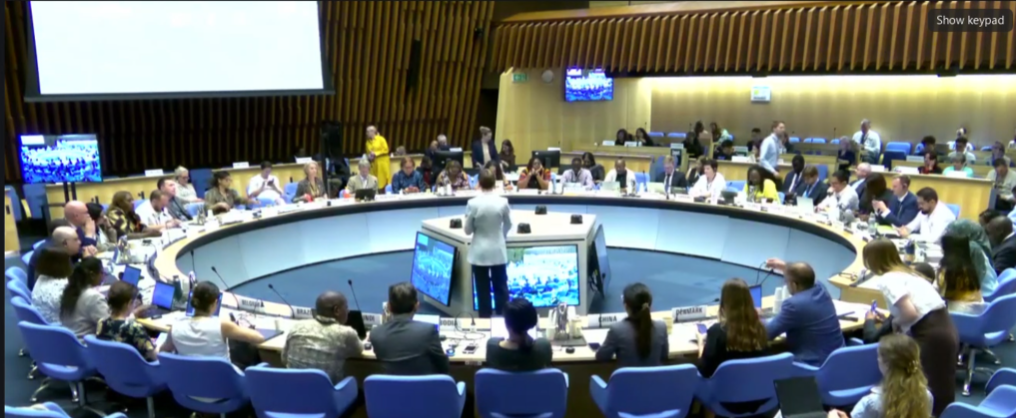
Interventions at the PCB Meeting Thematic Segment on Drugs
Youth RISE intervened three times at the UNAIDS PCB Meeting. In the session related to the future structure of UNAIDS after its announced sunsetting, Anton Basenko from INPUD delivered a statement on behalf of Youth RISE, Harm Reduction International (HRI), INPUD, and the International Drug Policy Consortium (IDPC) on how instrumental UNAIDS’ leadership on the HIV response has been to advancing the rights of people who use drugs. If the organisation is truly terminated, the World Health Organisation is the UN agency that is best set to take up UNAIDS’ drug-related responsibilities.
This year’s PCB Meeting included an in-depth Thematic Segment on Drugs entitled: “Beyond 2025: Addressing Health Inequities through Sustained HIV Response, Human Rights, and Harm Reduction for People Who Use Drugs” – a dedicated session that spoke to the global community of young people who use drugs that Youth RISE represents.
During the Thematic Segment, we had two opportunities to intervene on UNAIDS and Member States’ discussions on drugs.
In a panel discussion on addressing inequalities that prevent progress in the HIV response for people who use drugs, we highlighted the various social, economic and legal challenges that our communities face worldwide:
“Across the world, almost all people who use drugs face some form of criminalisation or discrimination that impacts their access to HIV care. As young people who use drugs, we’re concerned about these structural barriers, and how their impact is felt by our communities.
Addressing inequalities must mean ending the continued criminalisation of drugs and related interventions. Drug laws funnel young people into criminal or coerced-treatment systems at an early age with life-long consequences: criminal records limit people’s work and life opportunities, and abstinence-based treatment services offer little to no harm reduction interventions, leaving people more exposed to HIV and other harms, both within these places and as soon as they leave them.
It’s key to understand that health is highly shaped by structural, political, and social determinants, not just health factors. We need to recognise how our laws, employment, housing, immigration status have a significant impact on our HIV response. People’s individual choices play a role in reducing their risk of exposure and transmission; but these choices are shaped by the information available to us, and the support systems that we live in.
Drug criminalisation also affects access to evidence-based drug-related education, preventing people from sharing safer-use information with each other. Drug awareness campaigns targeting youth continue to be designed without youth input, meaning they often reflect state priorities rather than real needs. Not only are young people then left without knowing how to reduce the risks of HIV and other bloodborne virus transmissions, they’re often blamed for not participating in services they never designed.
Another serious inequality that must be considered is the need for harm reduction interventions that go beyond traditional male, adult injecting opioid use. The latest UNODC World Drug Report confirms changing drug markets and patterns of use, and the lack of interventions built for them.
With young people who inject drugs having a 50% higher average risk of HIV and HCV acquisition, and an increasing number of new psychoactive substances in circulation, HIV responses must prioritise full-spectrum harm reduction as a core, rights-based approach that addresses structural barriers to health and ensures the meaningful participation of young people who use drugs at all levels of policy design and decision-making.”
In another panel discussion on human rights protections through law and policy change, we highlighted the importance of UN-wide support for drug policy reform to safeguard communities’ human rights:
“We need a strong call from the UN now, more than ever, for Member States to ensure that drug policies are grounded in human rights, public health and evidence and that they do not create any barriers to HIV prevention, treatment and care.
Across the world, prohibition remains as the standard system of drug control, despite having not only failed in its own terms to reduce drug use, but having produced deadly systems of incarceration, discrimination and barriers to health service access that reduce access to prevention services, testing, treatment, harm reduction and other interventions.
Young people are routinely exposed to the harms of unregulated drug markets, unable to access information on how to stay safer around drugs, know what’s in their supply, or to seek help without fearing arrest or a life-long criminal record. We are disproportionately funnelled into juvenile detention or separated from our families for drug use. These consequences fall particularly hard on women, gender-diverse people and other marginalised groups.
While regulation is likely the best way to control drug markets and harms, Youth RISE strongly supports the adoption of decriminalisation as a baseline feature of an effective drug policy. This is not a radical suggestion: just last week, 19 UN Special Rapporteurs called for grounding drug policies in human rights and a shift to decriminalisation. We need a system that ends any punitive or compulsory measures towards those using drugs, and moves towards health and human-rights centered frameworks of drug harm control. Key features would be to automatically expunge criminal records for non-violent drug offences, reject coercive legal interventions that use the threat of punishment to enforce abstinence, and redirect funds from the criminal justice system to health and social services.”
Defending Harm Reduction Amidst Global Funding Strains
It was encouraging to see that in the adopted decisions from the 58th PCB session, the group requested Member States to create enabling legal and policy environments to effectively address HIV-related stigma and discrimination.
It was great to have the opportunity to voice the concerns of young people who use drugs worldwide at the PCB; it is within these spaces that Member States and UN agencies decide how communities will be funded and supported. At such a critical time, the rights of vulnerable and criminalised groups need to be brought to the forefront, ensuring that what comes after UNAIDS maintains its focus on human rights, community leadership and evidence-based developments.