For toomany years, young people who use drugs have heard our names invoked in the halls of global diplomacy. Whenever a policymaker steps up to a podium at the UN Commission on Narcotic Drugs (CND) in Vienna to defend punitive drug laws, criminalization, or militarized policing, they inevitably do so in the name of “protecting our children and youth.”
This autumn, Youth RISE continued to expand our advocacy footprint beyond Vienna. We brought the lived and living experiences of young people who use drugs at the 63rd Session of the UN Human Rights Council (HRC) in Geneva. Here is what went down, the events we co-sponsored during the unofficial ‘Drug Policy Week’ at HRC, and how young people are contributing in shifting the narrative in these high-level corridors.
1.- Plenary Statement on Youth Mental Health.
Mandated by HRC Resolution 57/30, the OHCHR launched its study on the Impact of mental health challenges on the enjoyment of human rights by young people (A/HRC/63/51). Because initial drafts frequently framed drug use exclusively through pathologizing language of “abuse” and “addiction,” Youth RISE mobilized our International Working Group (IWG) to submit inputs and delivered a formal 90-second video statement during the General Debate under Item 3.
Our intervention pushed the Council to move past moralistic and psychiatric framing, demanding that member states decouple substance use from criminalization and invest in youth-led, non-coercive harm reduction integrated within voluntary mental health care.
2.- Co-Sponsoring the High-Level Side Event on the Coca Leaf
Demonstrating our commitment to indigenous rights and drug policy justice on young people, Youth RISE formally served as an official co-sponsor for the high-level hybrid side event:
“From Flawed Review to Real Change: Indigenous and Peasants’ Rights and the Future of the Coca Leaf” (1 October 2026), organized by IDPC alongside, OHCHR, Elementa DDHH, Alianza Coca Para la Paz, Dejusticia, the Transnational Institute (TNI), WOLA, Viso Muton, and EHRA. (include flyer)
This event tackled the historical racism and colonial bias embedded in the international scheduling of the coca leaf, advocating for the protection of peasant and indigenous rights and demanding evidence-based reform within UN classification frameworks.
3.- Our main advocacy event: Youth and Drugs – Rethinking the Rules
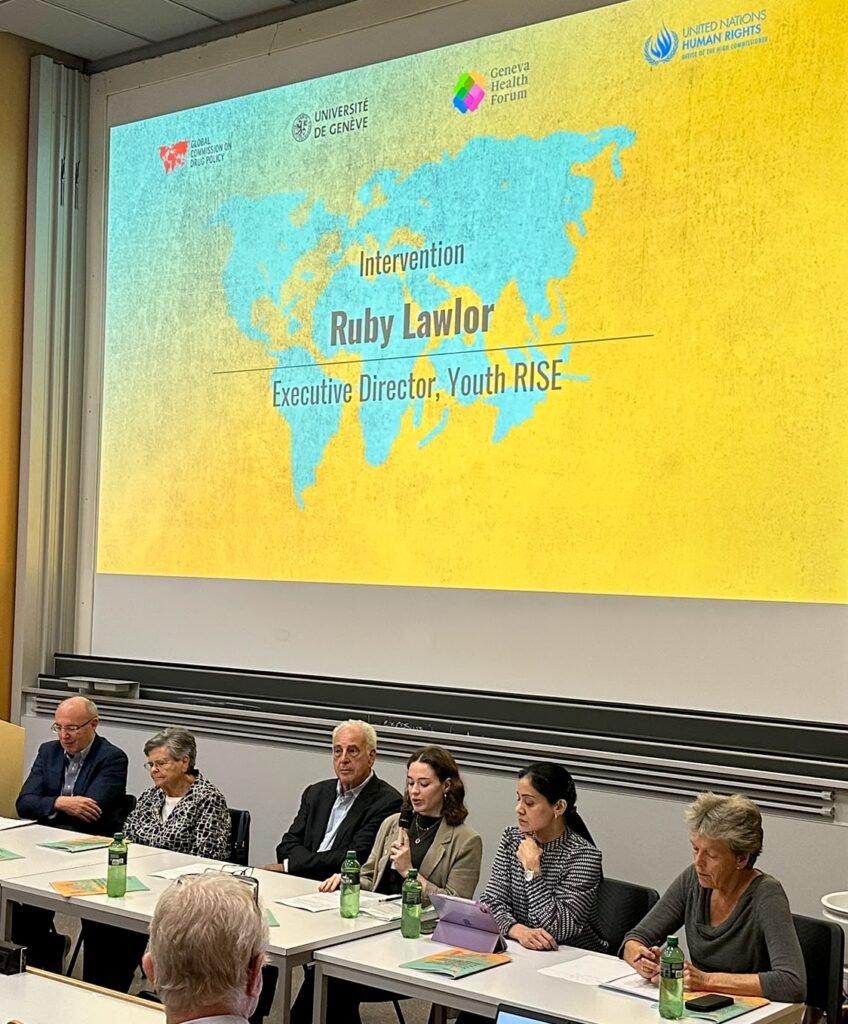
On 30 September, Youth RISE joined the Global Commission on Drug Policy and the Geneva Health Forum for a public plenary at the University of Geneva. Speaking alongside a powerful panel featuring GCDP Commissioner Michel Kazatchkine (former Executive Director of the Global Fund to Fight AIDS, TB, and Malaria), Ruth Dreifuss, Commissioner, Global Commission on Drug Policy and former President of Switzerland for the Opening remarks, Shivani Verma, Human Rights Officer, at the United Nations Human Rights (OHCHR), University of Geneva Clinical and Public Health Addictions specialist Barbara Broers, with the journalist Stéphane Bussard, from Le Temps as Moderator.
Executive Director from Youth RISE Ruby Rose Lawlor made the case for why dismantling punitive drug laws is a basic health and human rights imperative for young people worldwide.
“Young people are often consulted on how to stop or prevent young people from taking drugs. We are almost never consulted on the rest of it.
Children lose parents to prison because of drug offences. Children grow up with militarised drug enforcement on one side and armed groups on the other, and live with that violence every day. Children are recruited and exploited in illicit markets and then charged as offenders instead of protected as victims.
None of that is harm caused by drugs. All of it is harm caused by drug policy. And a lot of it happens in the name of protecting the young people it happens to.”
Ruby Rose Lawlor, Youth RISE, Executive Director.
Additionally, we engaged in critical dialogues across the week:
- We cosponsored the launch of the OHCHR thematic report on Women, Girls and Drug Policies (A/HRC/63/56) to highlight how punitive policies uniquely target young women.
- Supporting our IWG member Dr. Mihir Mumlesh in bringing regional South Asian youth realities to the Justice Project Pakistan (JPP) consultation on human rights-based drug policy, which had representation of the Chairperson of the National Commission for Human Rights of the Government of Pakistan, Ms. Rabiya Javeri Agha.
Help us carry these demands beyond UN corridors by reposting and sharing this dispatch across your networks. Link to social media posts.
Check more resources:
IDPC on Human Rights Council: https://idpc.net/subjects/hrc
Harm Reduction International on the 63rd Human Rights Council: https://hri.global/publications/63-human-rights-council-drug-policy-opportunities/