For decades, the global drug control system has operated under the pretext of protecting the health and welfare of humanity. Yet in practice, punitive drug policies have quietly subjected children and young people to criminalization, healthcare barriers, arbitrary family separation, detention, and institutional violence.
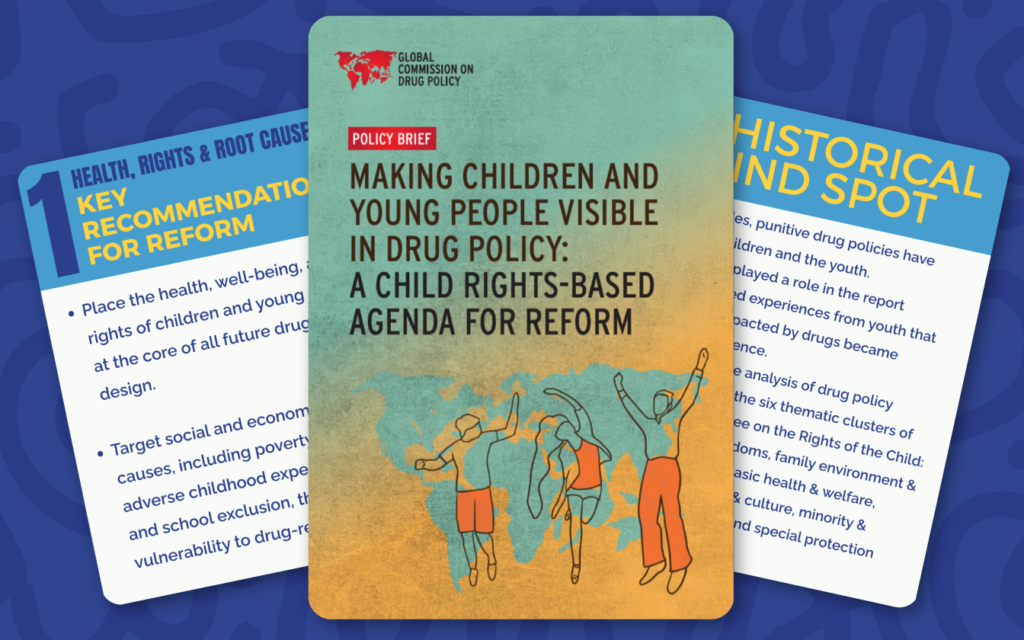
To challenge this contradiction and shift global governance, the Global Commission on Drug Policy (GCDP) launched its landmark policy brief: “Making Children and Young People Visible in Drug Policy: A Child Rights-Based Agenda for Reform.”
Youth RISE’ served as a partner ensuring meaningful youth engagement throughout the project, organising two dedicated youth consultations through our global network and partner organisations. As well as providing ongoing advice and feedback
We ensured that youth lived experiences and contextual realities were treated as essential evidence alongside legal standards and academic research:
- Methodological Guidance: Co-designed qualitative frameworks to ensure consultation processes effectively captured trauma-informed, real-world inputs from children and young people.
- Global & Regional Consultations: Spearheaded two major consultations within the Youth RISE network, one global session and one focused specifically on Latin America and the Caribbean.
- Supported GCDP for in-person consultations: through ensuring youth advocates participated in the various consultations around the world, bringing youth advocates into direct dialogue with UN officials, child rights advocates, health practitioners, and drug policy experts.
A Timely Opportunity for Global Reform
Grounded in the United Nations Convention on the Rights of the Child (UNCRC), the most widely ratified human rights treaty in history, this policy brief addresses a profound historical blind spot. While children and young people are frequently invoked to justify harsh enforcement, they remain routinely excluded from designing, implementing, and evaluating the policies that shape their lives.
As the UN drug control system undergoes unprecedented review through CND Resolution 68/6 and the broader UN80 process, a unique window has opened to realign global drug policy with the UN System Common Position on Drug Policy (2018), among other key human rights instruments, such as the UNCRC. This brief centres lived experiences and context realities of children and young people as crucial sources of knowledge and their participation and inclusion must be central in the design, implementation and evaluation of policies that shapes their lives. The report demonstrates that harm reduction must be understood not simply as a set of medical interventions, but as a holistic policy framework. Efforts to prevent or delay drug use must be paired with policies that uphold rights, minimize preventable harms, reduce exposure to state violence, and guarantee access to voluntary, evidence-based care.
Evaluating Policy Across the Six UNCRC Clusters, the analysis evaluates drug policy impacts through the six thematic clusters used by the UN Committee on the Rights of the Child:
- Civil Rights & Freedoms: Ending invasive surveillance, mandatory drug testing, and privacy violations carried out in schools and communities under the guise of “protection.”
- Family Environment & Alternative Care: Halting punitive enforcement that leads to arbitrary family separation, which disproportionately penalizes low-income, minority, and marginalized households.
- Basic Health & Welfare: Guaranteeing equitable access to youth-tailored harm reduction, voluntary mental health services, and essential controlled medicines.
- Education, Leisure & Culture: Eliminating exclusionary discipline, school drug testing, and policing that disrupt education and restrict safe recreational and cultural spaces.
- Minority & Indigenous Rights: Dismantling structural racial discrimination and culturally insensitive practices that drive the overrepresentation of Indigenous, minority, and migrant youth in justice systems.
- Special Protection Measures: Reframing the position of children involved in illicit drug economies, recognizing them primarily as rights-holders requiring social protection, community support, and diversion rather than criminal prosecution and detention.
To translate these findings into action, the policy brief outlines essential steps for governments, UN bodies, and civil society:
- Center Rights and Well-Being: Place the rights, health, and well-being of children and young people at the core of all future drug policy design.
- Address Structural Drivers: Target the social and economic root causes, including poverty, violence, adverse childhood experiences, school exclusion, housing instability, and service barriers, that increase vulnerability to drug-related harms.
- Expand Voluntary Care: Guarantee youth access to age-appropriate, evidence-based, and voluntary health and social services across the full continuum of care.
- Ensure Access to Medicines: Mandate that States provide equitable access to essential controlled medicines for children and young people who need them.
- Prioritize Family Preservation: Support caregiving capacity and address the underlying socioeconomic factors that drive child welfare interventions and family separation.
- Shift from Punishment to Support: Replace criminalization and detention with prevention, diversion, rehabilitation, and community-based support options.
- Protect Children in Drug Economies: Recognize children involved in illicit drug production or trade primarily as individuals in need of protection rather than criminal prosecution.
- Dismantle Systemic Discrimination: Confront structural racial and social bias affecting Indigenous peoples, ethnic minorities, migrants, displaced populations, and marginalized youth.
- Guarantee Meaningful Youth Participation: Actively include children and young people in designing, implementing, monitoring, and evaluating all drug policies and programs that impact their lives.