Written by Ruby Rose Lawlor, Executive Director, Youth RISE
Wednesday, 25 June 2026 (Dublin, Ireland) Yesterday, Ireland’s Joint Committee on Drugs Use published its Final Report, recommending that the State fully decriminalise the possession of drugs for personal use and move decisively towards a health-led approach. Twice, first in 2024, and again in March 2026, I was invited to appear before the Committee on behalf of Youth RISE, to bring the perspective of young people who use drugs into one of the most significant drug policy processes in the history of the Irish State. Reading the final 161 recommendations, I can see many of the messages I carried into that committee room reflected back.
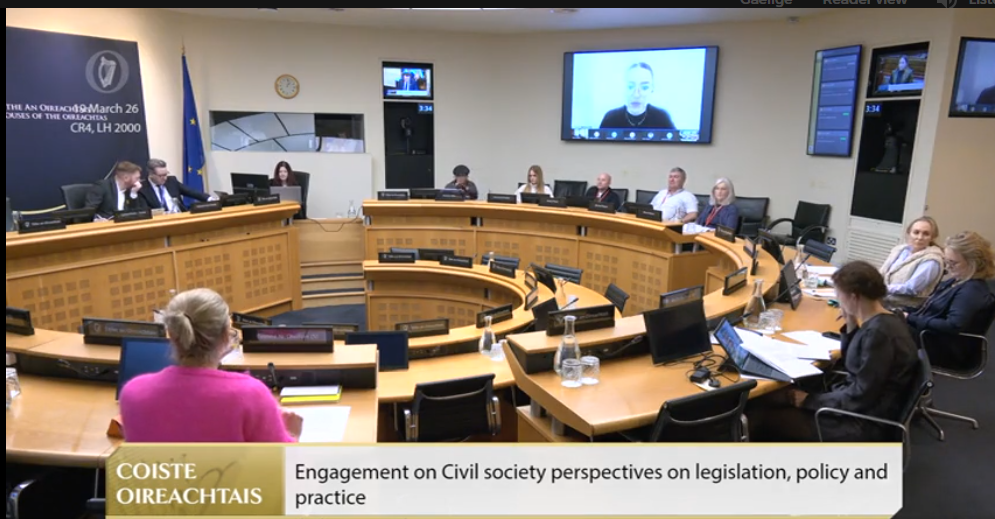
For me, these invitations carried a particular weight. I’m Irish, and long before this work took me into global drug policy spaces, I began campaigning for reform and harm reduction at home in Ireland. Being invited to speak at Leinster House to give evidence felt, in many ways, like coming full circle: bringing a global perspective back to the national conversation that first shaped me.
What the Committee is, and why it matters
The Joint Committee on Drugs Use was established by the Oireachtas (the Irish parliament) to respond to the Citizens’ Assembly on Drugs Use – the most comprehensive examination of drug use ever undertaken in Ireland. The Assembly brought together a representative cross-section of the public who heard the evidence, weighed the arguments, and made 36 wide-ranging recommendations: a whole-of-government approach to drugs, the meaningful involvement of people who use drugs in shaping policy, and the decriminalisation of personal possession, among many others.
The Committee, made up of TDs (MPs) and Senators from across the political spectrum, including independents, was tasked with examining each of those recommendations and providing a reasoned response. Its meetings follow a consistent format: invited experts (“witnesses”) deliver a short opening statement on the meeting’s theme, after which members question them on their statement and their wider views. It was in this setting, twice, that I was asked to speak.
2024: Making the case for reform
I first appeared before the previous edition of this Committee in 2024, for a session on decriminalisation, depenalisation, diversion and legalisation, alongside Niamh Eastwood of Release and Professor Alex Stevens. I set out the core of our argument: that the War on Drugs has been waged in the name of protecting young people, and yet young people are among those most severely harmed by punitive drug policies — exposed to criminal records and sanctions, pushed away from family, education and health services, and disproportionately targeted in marginalised communities.
I called on Ireland to decriminalise drug use and possession and to legalise and regulate all drugs, paired with serious investment in communities, youth-friendly harm reduction services, and honest, evidence-based drug education. I spoke to the limits of diversion, a welcome, but not a substitute for tackling the root causes of harm, and to the urgency of drug checking and harm reduction in the face of a toxic, unregulated supply and a rising overdose crisis. Much of this drew on the years I spent working on these questions in an Irish context, now sharpened by what I’ve learned advocating internationally.
Read my full 2024 opening statement here: https://youthrise.org/resources/2024-opening-statement-oireachtas-joint-committee-on-drugs-use/
The Committee’s 2024 Interim Report cited our evidence repeatedly — on the disproportionate impact of punitive policies on young people, the value and limits of the Garda Youth Diversion Scheme, voluntary and youth-tailored treatment, peer-led harm reduction, and the immediate case for drug checking to prevent deaths.
2026: From principles to implementation
When I was invited back on 19 March 2026, for a session on civil society perspectives within the Committee’s Legal Issues module – appearing alongside witnesses from UISCE Drug Support and Family Addiction Recovery Ireland – the conversation had moved on. Rather than re-arguing the case for reform, I focused on how the Citizens’ Assembly recommendations could translate into genuine protection for young people in practice.
I grounded my statement in the Assembly’s own roadmap: a health-led approach and the removal of criminal penalties for personal possession (Recommendation 17), accompanied by pathways to expunge past convictions; a whole-of-government and socio-economic response that treats poverty, housing and exclusion as drivers of harm (Recommendations 2 and 4); and age-appropriate prevention that complements, rather than replaces, harm reduction (Recommendation 28). Above all, I offered Full Spectrum Harm Reduction as a comprehensive prevention model, one that understands prevention not only as preventing drug use, but as preventing harm by ensuring access to healthcare, harm reduction, housing, education and employment, with young people meaningfully involved in designing and delivering the services that affect them.
This is the principle that runs through all of our work, and that I have carried from Irish community settings into global policy rooms: nothing about us without us. Policies are more effective when they are shaped by the people most affected by them, including young people who use drugs (Recommendations 10 and 33).
Read my full 2026 opening statement here: https://youthrise.org/resources/2026-opening-statement-oireachtas-joint-committee-on-drugs-use/
“Criminalisation of drugs, in reality, means criminalisation of marginalised communities.” — from my opening statement to the Joint Committee on Drugs Use
What landed in the Final Report
The Committee’s Final Report contains 161 recommendations. Many of them speak directly to the case I made:
- Full decriminalisation of all drugs for personal use. The Committee recommends repealing Section 3 of the Misuse of Drugs Act 1977, and is explicit that this should apply equally to all substances, not just cannabis or selected drugs. This was my central ask in both 2024 and 2026.
- A genuinely health-led approach that is defined as diversion, dissuasion and decriminalisation, with treatment and diversion that are voluntary, not coercive, and where refusal to engage carries no criminal sanction.
- Recognition of “policy harm” as a distinct factor in drug-related harm, including harms arising from criminalisation, stigma, stop-and-search and exclusion from services. This echoes an argument we have made for years: that punitive policies are themselves a source of harm.
- Drug checking on a legal footing, with policing arrangements that let people access these services without risk of arrest or prosecution, a measure I pressed for as an immediate, life-saving step.
- Naloxone made available over the counter, and provided to those at heightened risk, including people leaving prison or treatment.
- Harm reduction embedded in education and recovery with evidence-informed prevention that moves beyond abstinence-only messaging, and an explicit recognition that recovery does not always mean abstinence.
- Meaningful participation of people who use drugs in all policymaking, implementation and oversight structures, alongside protection for the autonomy and right to dissent of civil society organisations.
- Embedding human rights in Irish drugs legislation, strengthening the spent convictions regime, and reorienting Garda priorities away from possession and towards organised supply.
- Investment in youth and community work as prevention, and a whole-of-government response to the social determinants of harm.
The Committee also called for a standing Oireachtas Committee on Drug Use, so that this work continues to be scrutinised rather than shelved.
Reflections: a milestone, not a finish line
This is a significant moment. A cross-party committee, drawing on years of evidence and the testimony of people with lived and living experience, has concluded – in the words of its Chair, Deputy Gary Gannon, that criminalising people for their own drug use has not reduced harm, and that a health-led response is “not a softening of the State’s resolve on drugs; it is a more honest and more effective use of it.”
I want to be honest, too, about where the report stops short. The Committee recommends decriminalisation, but not the legalisation and regulation of supply that I argued is necessary to disrupt an increasingly toxic, unpredictable market – on cannabis specifically, it calls only for continued debate. Decriminalisation removes the criminal sanction from the person; it does not yet address the unregulated supply driving overdose risk. And recommendations are not yet law: the report now passes to Government, where the early response has been cautious, and the forthcoming National Drugs Strategy will be the first real test of whether this consensus translates into delivery.
For me, the deeper takeaway is personal as much as political. Having started this work in Ireland and carried it into international spaces, returning to give evidence to my own parliament, and seeing those arguments reflected in a cross-party report, is a reminder of why lived experience and youth voices belong in the room. When young people who use drugs are invited in, not as a token but as expert witnesses, the resulting recommendations are more honest, more grounded, and more likely to protect the people they are meant to serve.
Looking ahead
Ireland’s reform process sits within a growing international movement away from punishment and towards health, dignity and rights, which is a movement I see up close in our global work, and one I am proud to be part of advancing at home. I’ll keep working to ensure young people remain central to it, in Ireland and beyond. My thanks to the Committee for the invitation and the genuine engagement, to the civil society partners and people with lived experience whose voices shaped this report, and to the Youth RISE network whose work makes our advocacy possible.