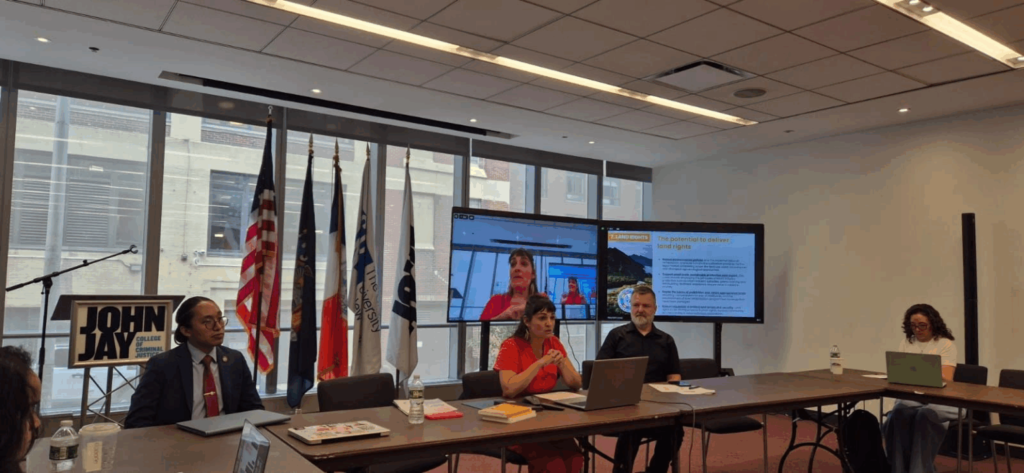
This statement was written and delivered by Teresa Castro (International Working Group member) during the side event “Strengthening Civil Society Voices in Drug Policy for Sustainable Development” organized by the Vienna NGO Committee on Drugs on July 17th at 10am EST.
The side event took place in a hybrid format on the occasion of the United Nations High-Level Political Forum 2025 in New York.
A recording of the side event will be made available on the VNGOC YouTube channel.
For follow-up or to join the ImPACT Coalition, please contact: info@vngoc.org
—————————–
Good afternoon. It is an honour to be here today, and I am truly grateful for this opportunity to represent a voice of civil society in drug policy.
My name is Teresa Castro. I was born and live in Lisbon, Portugal. I’m a social worker, a person who uses drugs, a member of Youth RISE’s International Working Group, and a peer collaborator at Kosmicare.
When applying to speak at this side event today, I initially tried to focus on good practice examples of collaboration between stakeholders and civil society in achieving the SDGs, but despite 12 years working in harm reduction, I struggled to find positive examples. So I decided to focus on the reality, instead of what should happen or sometimes (thankfully) does.
As we know, all SDGs are interconnected and cannot be achieved in isolation. But this year’s event focuses on five specific SDGs, two of which I want to highlight:
– SDG 3: Health and well-being
– SDG 17: Partnerships for the Goals
I don’t think it’s necessary to explain how drug policy and harm reduction are directly related to SDG 3. And SDG 17 clearly addresses the need to promote inclusive partnerships, including civil society.
So why are civil society perspectives on the harms created by punitive drug policies being discussed at a side event, and absent from the main agenda?
No SDG is currently on the right track. As a social worker, I must point out how health is mainly shaped by structural, political, and social determinants rather than any health-related factors. Yet, people are individually blamed for health outcomes when, in reality, what most influences our health is not the result of personal choices.
Health is a human right, not a privilege. And people who use drugs do not lose their human rights.
In this event, as in many others, we continuously hear how it is necessary to center policies on people, foster community participation and involvement in decisions that affect them.
Regarding drug use or drug policy, the SDG targets only mention the need to “Strengthen the prevention and treatment of substance abuse, including narcotic drug abuse and harmful use of alcohol”.
This narrative ignores harm reduction as an evidence-based, cost-effective, human rights and health-based approach, despite its clear and direct relevance as a response to many SDGs:
- SDG 3 (health),
- SDG 10 (reducing inequalities),
- SDG 16 (just institutions),
- SDG 17 (partnerships)
The Voluntary National Reviews are meant to unite governments, civil society, citizens, the private sector, and academia, showing how collaboration plays a key role in achieving SDGs. But formal civil society participation is limited and many major NGOs don’t contribute to public consultations or to the reports.
Marginalized communities, such as people who use drugs, are usually only given space in consultation processes or feedback on policies already decided, and rarely have real power to influence or challenge unjust laws or decision-making processes.
We are invited to talk, not to decide. To speak, but not to be heard. This is not meaningful participation,but tokenism: symbolic inclusion without power.
The few times I’ve been placed in “decision-making” spaces, it was as a social worker, not as someone with lived experience.
Even as a person who uses drugs, I’m often considered more acceptable for these spaces, while those most marginalized are excluded for being seen as “too disruptive”, when their voices are exactly the most urgent to be heard.
Choosing which voices are “worthy” to be listened to only perpetuates exclusion, and we can’t challenge inequality with more inequality. We must build universal systems, instead of selective ones that make health equity impossible to achieve.
Yet, it is consensually recognized that measures need to be adapted to local realities, that bottom-up approaches and community engagement are crucial for sustainable development, and that civil society organizations are often the ones creating responses that reduce inequalities.
One of the first official meetings of this event, “SDG 3 and interlinkages with other SDGs – Healthy lives” places the following question: ❝What policies are needed to ensure universal health for everyone, everywhere?”.
Well, we clearly have the answers to this, we know what works, what needs to be done, we know that the communities most affected by inequality should lead and not merely “benefit” from responses that impact them. Concrete tools, models, and good practices to reach SDGs are repeatedly discussed. What is missing is the political will to do it.
The UN SDG Partnership Guidebook, from 2024, even says: “All of the ideas, people, technologies, institutions and resources that are required to achieve the SDGs are already available (…)”
And so here we are, once again, at a side event that covers a topic that is not included in the main event: drug policy, the consequences of punitive approaches, the exclusion of people with lived experience.
When policies are not designed with us, they are not designed for us, and may end up reflecting institutional priorities instead of our real needs. And then people are blamed for not using services that were never designed for their realities in the first place.
If we truly mean to “leave no one behind”, then people who use drugs cannot continue to be excluded, criminalized, and stigmatized. Punitive drug policies must shift to human rights and health-based approaches, and harm reduction must be integrated into SDG dialogues and implementation frameworks. This is not just a matter of justice, but also a matter of effectiveness. Without this, the SDGs will keep failing those who need them the most.